Elon Musk Hair Transplant: What the Photos Can and Cannot Prove
We found no reliable public confirmation of an Elon Musk hair transplant. Here is why the graft counts, stages and prices online contradict each other.

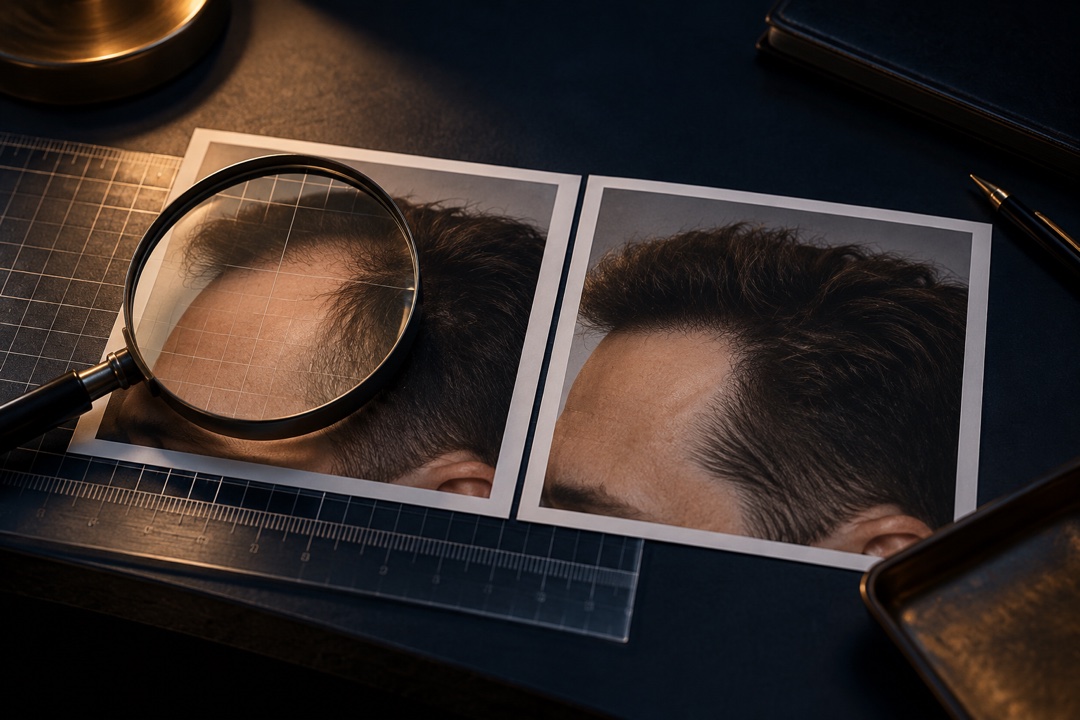
Did Elon Musk have a hair transplant?
We found no reliable public confirmation from Musk, a surgeon or a clinic, and no date or medical record in the public domain. Every graft count, Norwood stage and dollar figure attached to the Elon Musk hair transplant story is an estimate made by someone looking at press photographs, and those estimates disagree with each other by a factor of two to four.
That last part is the interesting bit, and it is the part nobody prints.
Search this topic and you will find a dozen pages that sound certain. They are almost all published by hair transplant clinics. Put their numbers side by side and the certainty evaporates: one says 2,500 grafts, another says 5,500. One says Norwood 3, another says Norwood 6. One says $12,500, another says $50,000.
This guide does something different. It lays out what is actually established, shows how far apart the guesses are, and then explains why a graft count cannot be read off a photograph at all, using the surgical literature and the profession's own census data. If you are here because you want the same outcome, the useful conclusion is at the end, and it is not about Elon Musk.
Free 1-page hair transplant quote checklist
Compare graft counts, surgeon involvement, included costs, follow-up and possible second sessions.
Table of contents
- What is actually on the record
- The Elon Musk hair transplant estimates contradict each other
- Why a graft count cannot be read from a photograph
- What the timeline does support
- The part of the story that surgery cannot explain
- What that kind of work costs in 2026
- What to take to a consultation instead of a celebrity photo
- Frequently Asked Questions
What is actually on the record
We found no reliable public confirmation of a hair transplant, medication, laser device or other hair treatment from Musk, a surgeon or a clinic.
Three claims circulate as though they were sourced, and none of them is:
"He admitted it to Rolling Stone." This appears on several clinic pages and in a great many social posts. No such quote exists in the interview archive, and the pages that repeat it cite each other rather than the magazine. Treat it as folklore.
"His surgeon confirmed it." No surgeon has ever claimed to have operated on him. The most-quoted expert comment came from a US hair restoration surgeon speaking to a celebrity news site in 2018, who described the change as "highly, highly likely" to be surgical and put the earlier loss at Norwood class III to IV. That is a professional opinion formed from photographs by someone who has never examined the patient. It is a reasonable opinion. It is not evidence.
"The before and after photos prove it." Photographs prove that his hair looked different in 1999 and 2007. They do not identify a cause, and photos taken years apart under different lighting, at different lengths, from different camera heights, are among the weakest possible evidence for anything to do with hair. We wrote a full checklist for reading these in the guide to hair transplant before and after photos, and press photography fails almost every item on it.
So the honest starting position is: something changed, the change is consistent with what a transplant does, and nobody outside his own doctor's office knows what happened. That is the normal state of affairs in this genre: only a short list of hair transplant celebrities has ever confirmed a procedure in their own words, and Musk is not on it.
The Elon Musk hair transplant estimates contradict each other
Six hair-restoration clinic pages sampled for this review made the claims below. They are not verified evidence about Musk; they are shown only to demonstrate how far the estimates diverge. The pages are left unnamed because the point is the spread, not who said it.
| Source | Norwood stage claimed | Grafts claimed | Cost claimed | Technique |
|---|---|---|---|---|
| Clinic page A | 3 to 4 | 5,000 to 5,500 across several procedures | $20,000 to $50,000 | FUT |
| Clinic page B | 4 | 5,000 to 5,500 total | $20,000 to $30,000 | FUT |
| Clinic page C | 4 | 2,500 to 3,500 | $12,500 to $35,000 at US rates | FUT |
| Clinic page D | 4, "perhaps 5" | not stated | $20,000 to $30,000 | FUT |
| Clinic page E | 5 to 6 | not stated | not stated | FUT |
| Clinic page F | not stated | not stated | not stated | FUT |
| 2018 press quote | 3 to 4 | not stated, "probably two procedures" | not stated | not stated |
Read down the columns. The stage estimates span Norwood 3 to Norwood 6, which is the difference between deep temple recession and a fully merged bald crown. The graft estimates vary by 2.2 times. The cost estimates vary by four times. Every one of these pages is describing the same handful of publicly available photographs of the same man.
The only column where everyone agrees is technique, and that agreement is not really about him. It is about what was available at the time, which we come to below.
When six confident answers to the same question differ that much, the correct reading is not that one of them is right. It is that the question cannot be answered from the available inputs.
Why a graft count cannot be read from a photograph
Graft counts are unreliable even when a surgeon is measuring the actual scalp in person, which is the strongest argument against estimating one from a picture.
A study of 39 hair transplant patients receiving more than 2,000 follicular units found that surgeons who measured the patient's own scalp laxity and donor density before surgery still estimated 2,139 grafts on average against an actual 2,398 delivered, a statistically significant gap (Huang et al, J Drugs Dermatol 2014). Direct measurement of a real head, by the person about to operate on it, was off by roughly 12%. A stranger looking at a magazine cover has none of those measurements.
The same study gives the density number that makes the rest of the arithmetic work: mean follicular unit density at the occipital scalp was 74.16 per cm². That is what untouched donor scalp carries.
Now compare it with what surgery places. Transplanted density is typically 30 to 40 grafts per cm², with anything above roughly 40 units per cm² classed as "dense packing" and its supposed advantages openly questioned in the literature (Unger, J Investig Dermatol Symp Proc 2005). The most-cited study of dense packing survival reported growth rates of 95.6% to 98.6% at densities from 23 to 72 grafts per cm², and its entire study population was one patient (Nakatsui et al, Dermatol Surg 2008).
A graft count is also an elastic figure in its own right, because a multi-hair follicular unit can be divided into more grafts without adding hair, as set out in the guide to hair transplant grafts.
So a transplanted area carries roughly half the density of scalp that never balded. It can look full, because hair covers hair and the eye reads coverage rather than counts. But "looks like he never lost it" and "has the density he had at twenty" are different statements, and only the first one is available from a photograph.
Then there is the scale of the numbers being thrown around. In the ISHRS 2025 Practice Census, a survey of the profession by the International Society of Hair Restoration Surgery, members reported a mean of 2,347 grafts in a first procedure and 1,637 in a subsequent one, with an average of 1.5 procedures per patient and a median of one. Only 2.2% of FUE cases and 1.5% of strip cases involved 4,000 grafts or more.
The internet's high estimate for Musk, 5,000 to 5,500 grafts, therefore describes a patient in the top couple of percent of all hair restoration surgery by volume. That may be true. It is also a claim nobody who published it checked against a denominator. If you want to know what a realistic session size looks like for your own pattern, the stage pages carry the graft ranges surgeons actually quote; Norwood 4 is the stage most often estimated for the earlier photographs.
What the timeline does support
One inference in that table has a reasonable historical basis: if a procedure happened in the late 1990s or early 2000s, strip harvesting would have been much more common than FUE.
Follicular unit extraction was not introduced to the peer-reviewed literature until 2002, in a paper that described it as an alternative for "certain patients" and reported that only about 25% of the patients biopsied were ideal candidates, with a further 35% good candidates (Rassman, Bernstein et al, Dermatol Surg 2002). In other words, at the moment FUE was named in print it was a niche technique with a screening test attached. Two decades later it accounts for 85.4% of male procedures, per the ISHRS census above.
So the era points to FUT, the strip method, which removes a band of scalp from the back of the head and leaves a linear scar. That is why several of those pages claim to see one in old photographs. Whether a particular shadow in a 2005 press photo is a strip scar is exactly the kind of judgement photographs cannot settle, but the technique inference itself is sound. If you are weighing the two harvesting methods for yourself, the difference in the mark they leave is covered on the hair transplant scars page.
One more date matters and almost nobody mentions it. Finasteride 1 mg was approved by the FDA for male pattern hair loss on 19 December 1997, under application NDA 020788. It reached pharmacies at the exact point in the timeline where the "before" photographs sit. Any man losing hair in his late twenties in 1999 was in the first cohort in history with a licensed oral treatment available to him.
The part of the story that surgery cannot explain
A hair transplant moves hair. It does not treat the condition causing the loss, and this is the single most important thing the celebrity-transformation genre leaves out.
The evidence for what happens without treatment is in the finasteride registration data. In the five-year study reported on the Propecia label, an independent panel rating standardised photographs found that 75% of men in the placebo group had visibly lost hair against baseline by year five, with 19% unchanged and 6% improved. In the finasteride group, 48% were rated as increased growth and 42% as no change.
Apply that evidence only to hair restoration in general, not to a diagnosis from photographs. A transplant does not stop loss in the native hair around it, so long-term appearance may reflect medication, additional procedures, styling, hair systems, photography, the natural course of loss or some combination. Public images cannot tell us which, if any, applies to a particular person.
The useful conclusion is that anyone considering surgery needs a plan for the hair that is not transplanted. A clinician can discuss whether medication, monitoring or a more conservative design makes sense for that individual.
Finasteride is prescription-only in most countries and carries real trade-offs. In the 12-month controlled trials on the label above, drug-related decreased libido was reported by 1.8% of men against 1.3% on placebo, erectile dysfunction by 1.3% against 0.7%, and ejaculation disorder by 1.2% against 0.7%; the label states these fell to 0.3% or less by year five and resolved in men who stopped. The reporting behind those figures has been criticised as inadequate across the trial literature, and European regulators added suicidal ideation to the product information at unknown frequency in 2025. The full picture, including where the meta-analyses disagree with each other, is in our guide to finasteride side effects. Minoxidil, the other mainstay, trades differently: scalp itching was reported by around 6% of men on the 5% solution against 1.1% on the foam, a temporary increase in shedding is usual in the first 12 weeks, and unwanted facial or body hair was spontaneously reported by 4% of 1,333 women across the placebo-controlled trials. The full picture is in minoxidil side effects, and the oral low-dose version increasingly prescribed off-label is set out in oral minoxidil for hair loss. None of these is a decision to make from a blog post.
What that kind of work costs in 2026
A 2,500 to 3,500 graft procedure may cost far less than the $50,000 figures attached to celebrity speculation, but high-end US pricing or multiple sessions can reach that level. That is why a graft estimate without a market, surgeon and session count cannot produce a credible price.
Rather than quote a headline range here, price your own case. The hair transplant cost calculator takes a graft count and a country and returns what clinics there actually quote, and the US cost page breaks down the per-graft rates behind it. A useful exercise is to run the two graft estimates from the table above and see how wide the resulting spread is; that spread is the honest answer to "what did it cost".
Two related reads if you are budgeting seriously: hair transplant cost for men covers what falls outside the quoted package, and hair transplant financing works through what the payment plans actually cost once the teaser rate ends.
What to take to a consultation instead of a celebrity photo
The worst way to open a hair transplant consultation is with a picture of someone else. It sets a target defined by another man's donor supply, skull shape, hair calibre and age.
Four things are worth more:
Your own stage, assessed honestly. Work out where you sit on the scale using the Norwood stage finder before anyone quotes you a graft number, so you can tell whether the quote matches the pattern.
A lifetime donor budget, not a session quote. Ask how many grafts your donor area can supply in total across your life, not just how many this operation will use. The ISHRS census shows a third of patients come back for a second procedure. A plan that spends the whole budget on a low hairline at 28 leaves nothing for the crown at 45.
A hairline designed for the stage you will reach, not the one you are at. The classic failure in this niche is a hairline placed for a 30-year-old that is stranded on an expanding bald scalp a decade later.
Clarity on who does the work. Ask which parts of the procedure the surgeon performs personally, which the technicians perform, and how many patients the clinic runs in a day. That single answer separates outcomes more reliably than any technique brand name.
Hair loss also has causes other than male pattern baldness, and some of them are treatable in ways surgery cannot address. If your hair has changed and you want to know why, a board-certified dermatologist or another qualified physician who specializes in hair restoration can examine the scalp, check for miniaturisation with a dermatoscope and rule out the medical causes that no amount of photo comparison will reveal.
Frequently Asked Questions
Did Elon Musk have a hair transplant?
It is unconfirmed. We found no reliable public acknowledgement from Musk and no surgeon or clinic on the record. Hair restoration surgeons who have commented did so from photographs without examining him.
How many grafts did Elon Musk's hair transplant need?
Nobody knows, and published estimates range from 2,500 to 5,500. For context, the ISHRS 2025 Practice Census reports a mean of 2,347 grafts in a first procedure and 1,637 in a subsequent one, with only 2.2% of FUE cases reaching 4,000 grafts or more.
What Norwood stage was Elon Musk before the change?
Published estimates put the earlier photographs anywhere from Norwood 3 to Norwood 6, which is most of the scale. Stage assessment relies on a consistent view of the hairline and crown, and press photographs taken years apart under varying lighting and hair length do not provide one.
Can medication alone produce a change like that?
Medication can protect and thicken existing hair, but it does not recreate follicles where none remain. The five-year Propecia study rated 48% of treated men as having increased growth against 6% on placebo. Whether medication, surgery, styling, a hair system or photography explains any particular public image cannot be determined from the image alone.
How Bald is an information site, not a clinic. Nothing here is medical advice and we do not sell procedures or medication. Figures are estimates with sources listed on our methodology page. Talk to a dermatologist or hair restoration surgeon before treatment.
More guides
Hair Transplant Before and After for Men: How to Read the Photos
Hair transplant before and after for men: what the captions leave out, what your donor supply can cover, and how to read a gallery honestly.
Hair Transplant Cost for Men: What Actually Changes the Price
Hair transplant cost for men depends on graft demand, donor supply, treatment area and whether one procedure will be enough.
Finasteride Side Effects: The Trial Rates, the Label and the Reports
Finasteride side effects by tier of evidence: what the randomised trials measured, what the label lists, and what the trials were never built to detect.